
Characteristics of 3D printer materials
Before we get into the different types of filament, let’s talk about some of the different characteristics of 3D printer materials. Each type of filament below may have some or all of these characteristics, to varying degrees.
- Durability refers to how much wear an object can take over time while still remaining functional. Decorative items usually don’t need to be durable, but if your print will have to withstand pressure or force over and over, you’ll want to choose a material that holds up to that usage.
- Strength is an object’s ability to withstand a weight or force applied to it without breaking.
- Flexibility refers to how much an object can bend, curve, or twist before breaking. Flexibility can also allow an object to absorb energy, which may make it more resistant to impact. Materials that are hard but have some flex can be less prone to shattering.
- Heat resistance is a material’s ability to withstand high temperatures without melting or warping.
- UV resistance refers to whether a material can withstand exposure to ultraviolet light from the sun or other sources without breaking down, fading, or weakening.
- Chemical resistance refers to a material’s ability to withstand exposure to oils, cleaning solutions, and other chemicals without breaking down.
How do I choose the right filament for my 3D print model?
The section below talks about the pros and cons of different filament types. As you read about them and think about your specific model, it might be helpful to ask yourself the following questions:
- What will this object be used for? Something that will need to withstand high temperatures, wear and tear, or impact might lead you to a stronger or more heat-resistant material like PETG or ABS.
- Will the object come in contact with food? Food safety is a debated topic in 3D printing. Filaments can differ by brand (some cheaper brands might use unsafe additives that higher-quality filaments don’t have), so we’d recommend looking for PLA filaments labeled “food safe” or “food grade” from a well-established company like Bambu Lab and doing your research on other potential concerns, like contamination from the nozzle and build plate.
- Where will the object be stored? High heat or regular sunlight exposure might require PETG or ASA.
- Is flexibility or shock absorption important? Something like a phone case would benefit from a flexible, rubbery material like TPU.
- Do I have the right equipment for a more specialized material? If your printer doesn’t have a heated bed or enclosure, you may not be able to use materials like nylon, ABS, or ASA.
- Do I have proper ventilation? ABS, ASA, and nylon in particular can emit harmful chemicals when printing. You’ll need space to keep your printer in a separate room away from where people sleep or work, with external ventilation or a large window with good air flow.
3D printer filament types and uses
Many different objects in our everyday lives are made out of plastic. But plastic is a broad term.
Think about a water bottle or milk jug, which has thin walls that can hold their shape, but can be easily crushed with a little force. Now, think about the hard walls of a PVC pipe, and the stretchy fabric of spandex leggings. All these objects are made of different types of plastic.
Along similar lines, the 3D filament types below might be produced with different materials and through different processes, but they are all considered thermoplastic. Here’s a 3D printer filament guide to the most common types you’ll see as a hobbyist.
PLA (Polylactic Acid)
Cost: Inexpensive (about $20/kg)
Strengths: Prints at a low temperature; durable; low-cost; comes in a variety of colors
Weaknesses: Relatively low heat tolerance (starts to soften and deform around 50-60 degrees C/122-140 degrees F); not as flexible or strong as other materials
Use for: Clips and holders, home organization, toys, models, rapid prototyping
PLA is the most common filament type for at-home 3D printing. It’s strong, user friendly, and doesn’t need any special treatment such as a heated bed or ventilation. It’s also cheap, readily available, and suitable for most home uses, making it perfect for beginners.
Some manufacturers also have what’s called PLA+, which is PLA mixed with other chemicals to make it stronger and more durable under stress.
If your print doesn’t have any special requirements, there’s no reason not to stick with PLA. You don’t have to get frustrated by the more finicky printing settings that exotic filaments require. As a bonus, PLA comes in lots of colors and fun finishes for you to choose from.
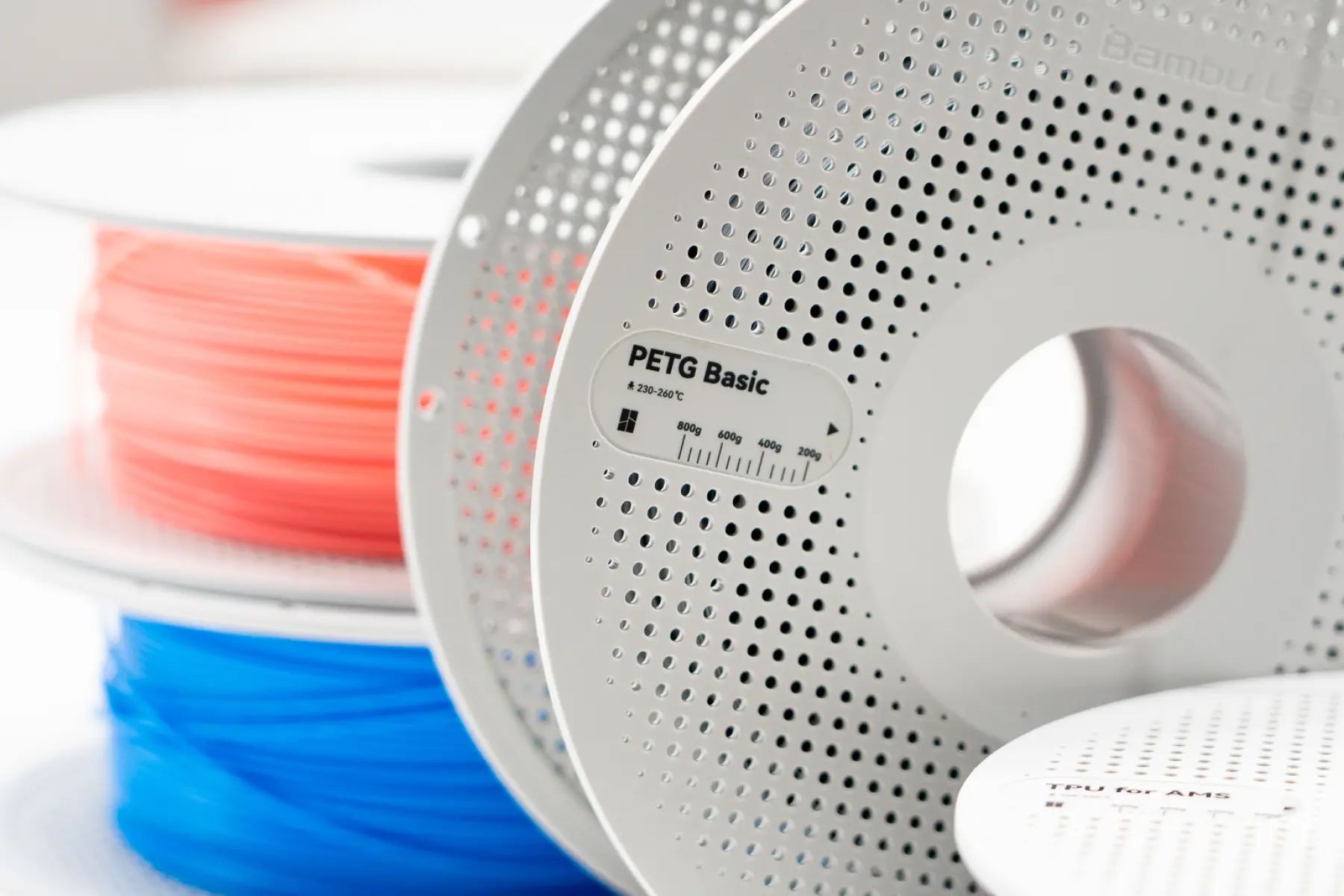
PETG (Polyethylene Terephthalate Glycol)
Cost: Inexpensive (about $20/kg)
Strengths: More durable and impact-resistant than PLA; higher heat tolerance (starts to deform around 65-70 degrees C/149-158 degrees F; high UV resistance; fewer noxious fumes than ABS; chemical resistance
Weaknesses: Can be difficult to print; stringing is common; parts may stick to bed and be difficult to remove; challenging to glue and paint
Use for: Outdoor tools, interior car brackets and mounts, sturdy toolboxes and covers
PETG has some similar strengths and characteristics with ABS. It can withstand higher temperatures and UV exposure, making it a great option if you want to create a custom cell phone mount for your car or a cover that’s exposed to the sun. It’s strong and durable for high-use, functional parts. It doesn’t release noxious fumes or require an enclosed printer, like ABS does.
However, PETG can be harder to work with in some ways. Prints can adhere to the bed too much and be difficult to remove. You may also find that your prints are stringy, so retraction settings need to be finely tuned to avoid this.
ABS (Acrylonitrile Butadiene Styrene)
Cost: Inexpensive (about $20/kg)
Strengths: More durable and impact-resistant than PLA; higher heat tolerance (starts to deform around 80-100 degrees C/176-212 degrees F)
Weaknesses: Heated bed and enclosure required; ventilation required; more prone to printing challenges
Use for: Sturdy toolboxes and covers, mechanical components, interior car parts that aren’t exposed to sunlight
ABS is known for being stronger than PLA. It has some flex, meaning it is more impact resistant and able to hold up under stress without breaking. It can also handle heat better, but it isn’t UV resistant. Printing ABS is more challenging because it requires some specialized equipment such as a heated bed, and larger models are prone to warping. It also releases toxic fumes and requires an enclosed printer and ventilation system.
ASA (Acrylonitrile Styrene Acrylate)
Cost: Moderately expensive (about $30/kg)
Strengths: More durable and impact-resistant than PLA; high heat tolerance (starts to deform around 95-100 degrees C/203-212 degrees F) and UV resistance; chemical resistance; smooth matte finish
Weaknesses: Heated bed required; enclosure recommended; more prone to printing challenges
Use for: Functional outdoor parts and fixtures, garden tools
ASA has some similarities to PETG and ABS in that it’s stronger and more resistant to heat and UV light. Many users also like that it prints with a smooth finish that’s matte instead of glossy.
Like ABS, ASA also requires a heated bed, and an enclosure is recommended to reduce warping. It is also a little more expensive than ABS and PETG.
TPU (Thermoplastic Polyurethane)
Cost: Moderately expensive (about $35-$40/kg)
Strengths: Extreme flexibility and durability, shock absorption, chemical resistance
Weaknesses: Prints at a slower speed, low rigidity, difficult to sand; may not be compatible with automatic material systems
Use for: Phone cases, electronic cases, grips, toys, door stoppers
TPU is very flexible, durable, and impact resistant, making it a great choice for protective cases or coverings. It has a consistency similar to rubber, with the strength of plastic. Many manufacturers have different TPU options with various levels of hardness, allowing you to get the flexibility you want.
TPU does need to print at a slower speed because of its consistency — trying to increase the speed might cause the filament to stretch or get stuck in your extruder.
Nylon (Polyamide, or PA)
Cost: Expensive (about $40/kg; composite and industrial grades can cost significantly more)
Strengths: Extreme durability, high heat tolerance, resistance to wear
Weaknesses: Very sensitive to moisture; prints at extremely high heat; requires heated enclosure and bed adhesive; requires good ventilation
Use for: Functional parts that hold up to wear, clips, gears, snap-fit joints
Nylon, also known as polyamide, is an extremely strong material that holds up well to heat and wear. It’s more expensive than most other filaments, but if you need to make something durable, it’s one of your toughest options. Nylon is sometimes sold as a blend with carbon fiber (CF) or glass fiber (GF), which can make it even stronger, but these options require a special hardened steel nozzle.
Nylon needs very high temperatures, so your 3D printer needs to be able to reach 240-280 degrees C. A heated bed and enclosure are required to maintain those high temperatures, as well as a good ventilation system. You may also need to use a bed adhesive such as a glue stick. Nylon must be stored properly in an airtight dry box with desiccant packs.
Does the quality of filament matter?
You can purchase filament from many different online retailers, but it’s important to know that not all filament is created equal. The quality of filament matters, too.
As a starting point, you can expect to pay around $20 per kilogram for PLA (give or take a few dollars). If you’re seeing PLA for much cheaper than that, it’s probably lower quality and could contain impurities or have inconsistencies in thickness. This can lead to failed prints and clogged nozzles.
If your printer manufacturer sells filament, you might find it easy to stay within that ecosystem. You’ll know that the filament was designed to work well with your printer and that company’s slicer software. Your manufacturer’s website will have specific recommendations for how to use them together.
How to store 3D filament
Filament needs to be kept dry — any absorbed moisture will steam when the plastic is heated, causing bubbling, stringing, and other problems when printing. Some types of filament are more hygroscopic than others, meaning they absorb moisture more easily and quickly. Nylon, for example, is highly hygroscopic and will absorb moisture from the surrounding air within a few hours.
Many people store PLA out in the open or loaded on their printer without issue, and if you live in a low-humidity area you could try this as well. Other filaments should be stored in an airtight container when not in use, ideally with desiccant packs (like silica gel packets) to absorb moisture.
If your filament does get wet or absorb moisture over time, you should dry it before printing with it. Many 3D printer manufacturers sell special drying ovens or have instructions for drying their filament on your enclosed, heated printer bed. You can also use an old food dehydrator, but don’t use it for food afterward. Look up the recommended drying time and temperature for your specific filament on the manufacturer’s website — if you use too high a heat, your filament might melt and stick together.
Design your model
Now that you know what types of filament are out there, check out our article on how to design models for 3D printing. Knowing what materials are available, and their different properties, might give you inspiration for your next model.